Bird deterrents in San Diego
Our approach to bird deterrents focuses on humane, targeted solutions that identify perching and nesting sites, evaluate the species involved, and recommend the deterrent your San Diego property deserves.
How do you keep birds off a house or building?
Block the spots they land and nest (ledges, beams, vents, solar panels) with spikes, netting, wire or screens, and clean up droppings and nesting material. Most native birds and their active nests are federally protected, so timing and method matter.

Inspect to find roosting and nesting sites
We identify the species and the ledges, vents, eaves, panels, or gaps birds use to roost and nest. Effective deterrents target the exact sites causing the problem — humanely and legally.

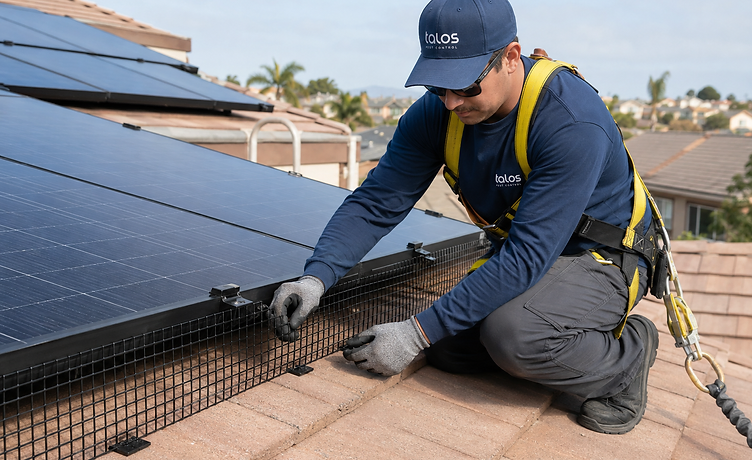
Humane deterrents and exclusion for lasting results
We recommend and install appropriate deterrents — screening, ledge exclusion, and habitat changes — and exclusion to keep birds from re-entering the structure, all in line with local wildlife regulations.
Bird droppings can carry bacteria and corrode paint and metal over time, which is why deterrents matter before nesting becomes deeply established.
Get a Quote →Common bird deterrents
| Method | Best for | Notes |
|---|---|---|
| Spikes | ledges, signs, beams | stop landing; humane, no harm to birds |
| Netting | courtyards, eaves, open structures | keeps birds out of an area |
| Bird wire | ledges and parapets | low-profile option |
| Vent and solar-panel screens | dryer and attic vents, rooftop solar | stops nesting under panels and in vents |
| Cleanup and sanitizing | areas with droppings | done with protective equipment |
Our bird deterrent process
Inspect
Identify the bird species and map the ledges, vents, eaves, solar panels, and gaps where birds roost or nest around the property.
Identify
Assess species behavior, nesting season, and protected-status rules so the deterrent strategy is humane, effective, and compliant with wildlife regulations.
Exclude & Deter
Install species-appropriate deterrents — screening, mesh, ledge exclusion, and habitat changes — targeting the exact roosting and nesting sites causing the problem.
Prevent & Follow Up
Recommend ongoing habitat and exclusion adjustments, then return to reassess and adapt the deterrent approach if bird activity persists between visits.
Signs of a bird problem
Birds aren’t always a problem — but when droppings, nesting, or noise persist, deterrents are worth considering.
Get a QuoteRepeated bird droppings on ledges, patios, walkways, or vehicles
Nesting material in vents, eaves, soffits, or under solar panels
Persistent bird noise, especially at dawn during nesting season
Birds gathering in the same spot day after day
Droppings staining or corroding surfaces and fixtures
Damage to screens, vents, or roofing from repeated activity


If birds come back, so do we
Talos stands behind our bird deterrent service. If activity continues between scheduled visits, our technicians will return at no additional cost to reassess and adjust the deterrent approach.
Get a QuoteUnderstanding & preventing bird infestations
Knowing why birds are drawn indoors is the first step to keeping them out. Below, the conditions that invite activity — and the steps that help prevent it.
The conditions that draw birds indoors
Roosting & nesting sites
Ledges, eaves, vents, signs, solar panels, and roof gaps offer birds sheltered places to roost and nest.
Food & trash
Open trash, pet food, fruit trees, and outdoor dining attract birds and keep them nearby.
Landscaping
Dense trees and hedges near the home provide staging and nesting habitat.
Easy access
Gaps in vents, soffits, and screens let birds enter attics and wall voids.
Colony behavior
Some species gather in flocks, so a few birds can quickly become dozens.
Year-round pressure
San Diego’s mild climate sustains bird activity across every season.
How to help prevent bird activity
Cover trash and keep pet food and outdoor dining areas clean.
Install hardware cloth or vent screens to keep birds out of attics and soffits.
Trim dense trees and hedges near the home to reduce nesting habitat.
Block gaps under solar panels to prevent nesting and droppings buildup.
Avoid leaving food or standing water that attracts birds overall.
Have recurring roosting assessed before nesting becomes established.
Bird laws to know
The federal Migratory Bird Treaty Act protects most native birds, their eggs and active nests, so those nests can’t be removed while in use. Feral pigeons, European starlings and house sparrows aren’t covered by that law. We plan deterrent work around active nests.
Source: U.S. Fish & Wildlife Service.
Bird deterrent work that is humane and durable
Birds nesting on eaves, solar panels, and HVAC equipment cause a specific set of problems: droppings that stain and corrode, nesting material that blocks airflow, and the mite and insect activity that follows a nest indoors.
The species we handle
Pigeons, sparrows, and starlings are the usual residents on San Diego roofs, with swallows and others in some areas. Native and protected species require a different approach and different timing, and we follow the regulations that apply to them.
Exclusion rather than removal
Deterrent work uses physical exclusion, netting, and ledge modification to make a surface unusable for nesting rather than harming the birds. That is what makes the result durable, since a nest removed from an intact ledge gets rebuilt.
Cleanup and sanitation
Once the area is clear, droppings and nesting material need to be removed and the surface treated before exclusion goes in. This is also the step that resolves the mite and insect activity downstream of an active nest.
Bird deterrent service summary
- Assessment of species and nesting pressure points
- Physical exclusion, netting, and ledge modification
- Cleanup and sanitation after the area is cleared
- Coordination on protected species requirements
- Follow-up to confirm exclusion is holding
Bird control near you
Serving San Diego County
Active across San Diego County — coastal communities, inland neighborhoods, North County, East County, and South Bay.
What San Diego property owners say about our bird deterrent service
“My technician, Antonio, was wonderful! He was professional, thorough, and kind. I had many questions, and he took time to respond to them. I highly recommend Talos Pest Control!”
“Talos is the best! Always on time, communicate what is going on, friendly and great value. Highly recommend!”
“I had an excellent experience with TALOS Pest Control Company from start to finish. The entire process was smooth, professional, and efficient. The employee’s starting with the technician, Fernando Romero along with setting up my account with Robert Whitehead, were truly exemplary. They were punctual, knowledgeable, and took the time to explain everything clearly, which made me feel confident and well-informed. Fernando and Robert were not only thorough in their work but also very respectful of my home. They addressed all my concerns for the front and backyard and the property, they ensured that the treatment was done carefully and effectively. Their attention to detail and commitment to quality service really stood out. I’m extremely satisfied with both the service and the overall process. I would highly recommend TALOS Pest Control to anyone in need of reliable and professional pest control service. Five stars all the way! Thank you TALOS!”
“We’ve had a great experience with Talos Pest Control at Luminary at Côta Vera. Our service technician, Fernando Romero, has been outstanding. He is professional, knowledgeable, reliable, and always takes the time to address any concerns thoroughly. Since Fernando began servicing our property, he has been proactive, communicative, and has done an excellent job staying on top of pest control needs throughout the community. His attention to detail and commitment to quality service have made a noticeable difference. We truly appreciate Fernando’s hard work and highly recommend Talos Pest Control for anyone looking for dependable, professional pest management.”
Questions, answered
When birds roost or nest on ledges, under panels, or in vents, droppings can damage surfaces, create slip hazards, and pose health concerns. Persistent noise at dawn and nesting in structures are also common complaints.
Yes. Talos focuses on humane deterrents and exclusion — preventing roosting and nesting without harm — in line with local and federal bird protection regulations. Species identification matters, since many birds are protected.
They enter through gaps in vents, soffits, and damaged screens. Sealing these openings and installing vent screening keeps birds out of wall voids and attics where they can nest and cause damage.
We identify the species and the exact roosting or nesting sites, then apply humane deterrents and exclusion — screening, ledge exclusion, and habitat changes — and follow up to keep birds from re-establishing.
Inactive nests can usually be removed. Active nests of protected native species have to be left until the young have left; we can install deterrents once they’re gone.
Yes. Spikes and wire stop birds from landing; they don’t injure them.
Yes, pigeons often nest under rooftop panels. Mesh screening around the panel edges keeps them out without drilling into the panels.
Take back your home with a pest control plan built around you.
Talos has pest control experts throughout San Diego County. Get a personalized quote and a tailored plan built around your home.
Related pest control resources
Why Pests Invade Homes in San Diego
Learn how infestations happen and how to stop them.
Read Article →Service PlansGeneral Pest Control Plans
One-time and recurring pest control options for different needs.
View Plans →CoverageSan Diego Pest Control Service Areas
Coastal, inland, North County, East County, and South Bay.
Our Service Areas →Sources
- U.S. Fish & Wildlife Service · Migratory Bird Treaty Act
Nesting, deterrent and legal guidance above follows these federal and university references. They describe general rules, not conditions at any single property.